 Minor Titles Quarterly
Small games, examined closely
Minor Titles Quarterly
Small games, examined closely
Review
Eleven hours · one playthrough
Minor Titles Quarterly
Small games, examined closely
Every farming game of the last decade has been about acquiring more land. This one gives you three planting beds, no route to a fourth, and eleven hours in which the only thing that can improve is your judgement. It took me four hours to stop resenting that and one more to understand it.
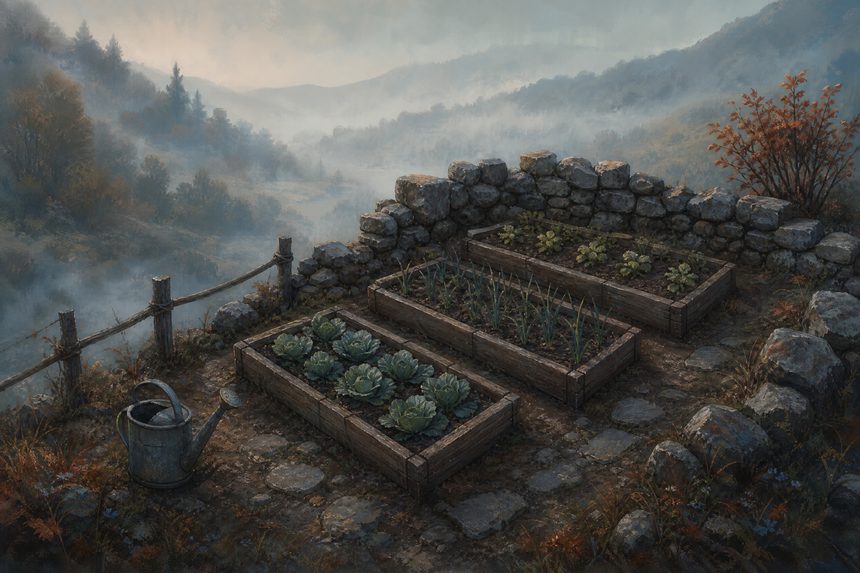
You have three raised beds on a hillside, a watering can, a stone wall that keeps the wind off, and a kettle in a hut behind you. Over eleven hours you will plant those three beds perhaps sixty times, and at no point will the game offer you a fourth bed, a larger can, a second hut, a shop, a coin, a neighbour to impress or a reason to expand.
I spent my first four hours waiting for the expansion to unlock, because I have played this genre and I know how it works. Around hour five I accepted that it was not coming, and the game I had been playing impatiently turned into a different game entirely.
The absence is not concealed. There is no locked plot of land visible at the edge of the map, no crumbling fence implying future work, no menu entry greyed out. The hillside simply ends where the wall is, and the wall is not a gate.
This matters because a locked expansion changes how a player reads every hour before it. If a fourth bed might arrive, the three I have are provisional, and my attention goes to the transition rather than to the beds. By declining to imply growth at all, the game moves my attention to the only place it can go, which is what is actually planted.
A game that cannot expand has to become interesting in place, and it turns out that three beds are enough surface for that if nothing else is competing.
Judgement, mostly. With three beds and roughly a dozen things that can be planted in them, the interesting question is never what to acquire but what to give up, and that question does not get easier as the hours accumulate.
Each crop has a season, a water requirement and a relationship to what was planted in that bed previously, and these three constraints intersect badly on purpose. By hour seven I was keeping a written note of what each bed had held, because the game does not track it and because the wrong sequence produces a bed that will grow nothing well for two seasons.
That written note is, I think, the actual content of this game. Not the planting, but the developing model of three small plots of ground that exists only in the player's head and on the player's paper.
| Constraint | Effect on a three-bed farm |
|---|---|
| Season windows | Two crops always compete for the same bed |
| Water demand | One can limits how many thirsty crops coexist |
| Previous occupant | Wrong sequence spoils a bed for two seasons |
| No storage | A harvest must be used before the next is due |
There is a kettle in the hut and you can put it on at any time. It takes about ninety seconds of real time to boil, during which nothing happens and the game does not pause.
I assumed this was decoration until hour six, when I noticed that I was putting the kettle on before every difficult decision, and that the ninety seconds of nothing was the interval in which I worked out what to plant. The game has no thinking phase, no menu to deliberate in, and no pause; it has a kettle, and the kettle is where the deliberation goes.
Whether that was designed or discovered by the player is impossible to know from outside, and it does not matter much. It is the best-used ninety seconds in any game in this issue.
The eleven hours are not evenly good. Hours two to four, before the absence of expansion becomes legible, are genuinely frustrating, and I suspect most players stop there. A game this confident about its scale should be more willing to say so early; a single line in the opening would cost nothing and would save the four hours I spent waiting.
The other problem is the note-taking. Requiring the player to track bed history on paper is defensible as a design position, but the game also does not tell you that this is necessary, so the first two spoiled beds feel like a bug rather than a lesson. There is a difference between withholding a convenience and withholding the information that the convenience is missing.
| Element | Assessment |
|---|---|
| Hours five to eleven | Excellent; the game's real shape |
| Hours two to four | Frustrating; expansion expected and absent |
| Bed history | Must be tracked on paper, unannounced |
| The kettle | The best-judged ninety seconds here |
A farming game whose refusal to expand is the reason it works, undermined by a first act that does not admit to the refusal. If you can get to hour five, the remaining six are the most attentive thing in the genre I have played. Many players will not get to hour five, and the game has only itself to blame for that.