 Minor Titles Quarterly
Small games, examined closely
Minor Titles Quarterly
Small games, examined closely
Review
Nine hours · one playthrough
Minor Titles Quarterly
Small games, examined closely
You never meet a suspect, visit a scene or reach a conclusion. You work in a records room, and detectives elsewhere in the building depend on documents you have not yet found. Nine hours of cross-referencing, and the most absorbed I have been by anything this year.
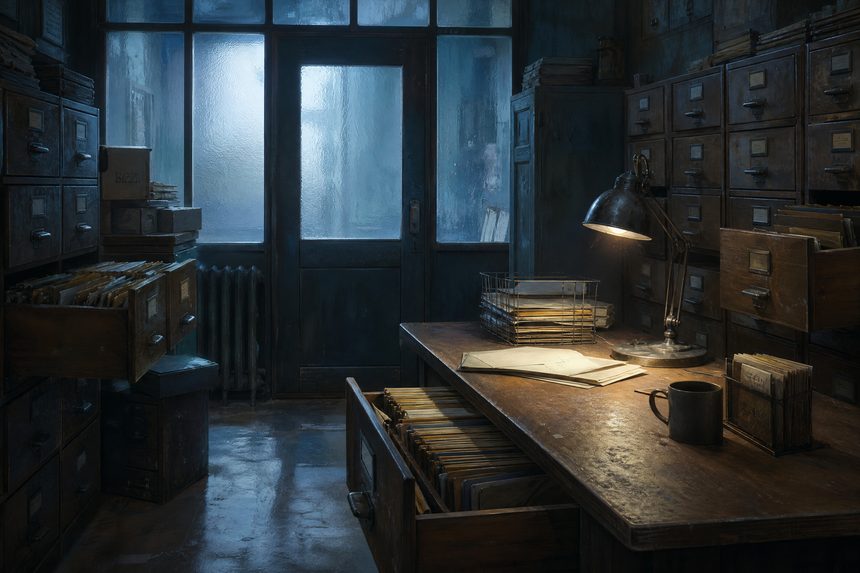
A slip of paper comes through a slot in the door. It asks for a document by a partial reference, a rough date, or in several cases a description of what the document is thought to contain. You find it, if it exists, and put it in the tray. That is the loop, repeated for nine hours.
Nothing in the game explains why any request has been made. There is a case going on somewhere in the building and you are not part of it, except that every piece of paper you locate is presumably part of it, and the ones you cannot locate are presumably a problem for somebody.
The requests are the writing, and they are extremely good. A slip that asks for a licence application from a specific quarter is administrative. A slip that asks for the same application again, four hours later, with a note that the copy provided was incomplete, is a small event in a story you cannot see.
By the middle of the game I was reading the slips as a narrative, which they are, and which the game never acknowledges they are. Requests cluster around certain addresses. A name appears in three unrelated document types. Someone upstairs is looking for something specific and does not want to say what.
You are given every fact in the case and none of the case, and the gap between those two things is where the whole game lives.
The game's central decision is that no request is ever explained and no outcome is ever reported. You do not learn whether the document you found mattered, whether the case was resolved, or whether the person the slips keep circling was guilty of anything.
This should be unbearable and is instead the reason the game works. Because nothing is confirmed, everything I noticed remained mine, and by hour seven I had a theory I could not test and did not want tested. A game that resolved this would be a much lesser thing, and it very nearly does resolve it, which I will come to.
Around hour six I opened a drawer and found it in the wrong order. Not shuffled, not empty: sorted correctly by the wrong field, as though somebody had refiled it in a hurry using a different convention from the one the rest of the room uses.
Nothing marks this. No slip refers to it, no message appears, and the game does not care whether you notice. But the drawer covers the addresses the requests had been circling for two hours, and the implication, which the game will never confirm, is that somebody had been in this room before me and had been looking for the same things.
I re-sorted it. It took eleven minutes, no request had asked for it, and it is the best thing I did in any game this year.
| What the game provides | What it withholds |
|---|---|
| Several hundred documents | Any statement of the case |
| Requests with partial references | The reason for any request |
| A physically consistent room | Confirmation that you noticed anything |
| One drawer sorted wrongly | Any acknowledgement of it |
The final twenty minutes almost ruin it. A last sequence of slips arrives which, read in order, does effectively state the case, and it converts eight and a half hours of inference into a summary I had not asked for. It is not a cutscene and it is not explicit, but it is close enough to explicit that the drawer I re-sorted became, retroactively, a clue rather than a suspicion.
The other complaint is mechanical. Searching is done through a drawer interface that is deliberately slow, which is correct for the first three hours and tedious for the last three. There is a difference between a game asking for patience and a game asking for the same twenty seconds four hundred times, and this crosses that line somewhere around hour six.
| Element | Assessment |
|---|---|
| Hours one to eight | Exceptional; inference without confirmation |
| Final twenty minutes | Explains too much |
| Drawer interface | Right early, tedious late |
| The wrongly sorted drawer | The best moment in this issue |
Nine hours of filing that produce a better detective story than most detective games, spoiled slightly by an ending that could not resist telling me I had been right. I cannot recommend it to anyone in general terms, and I have thought about that drawer more than about anything else I played this year.