 Minor Titles Quarterly
Small games, examined closely
Minor Titles Quarterly
Small games, examined closely
Lead review
Four hours · played twice
Minor Titles Quarterly
Small games, examined closely
Two developers, one mechanic, eleven rooms and no dialogue at all. This is the smallest ambition in the issue and the most completely realised, and the reason is not talent but arithmetic: four hours of content can be revised until it is right, and forty cannot.
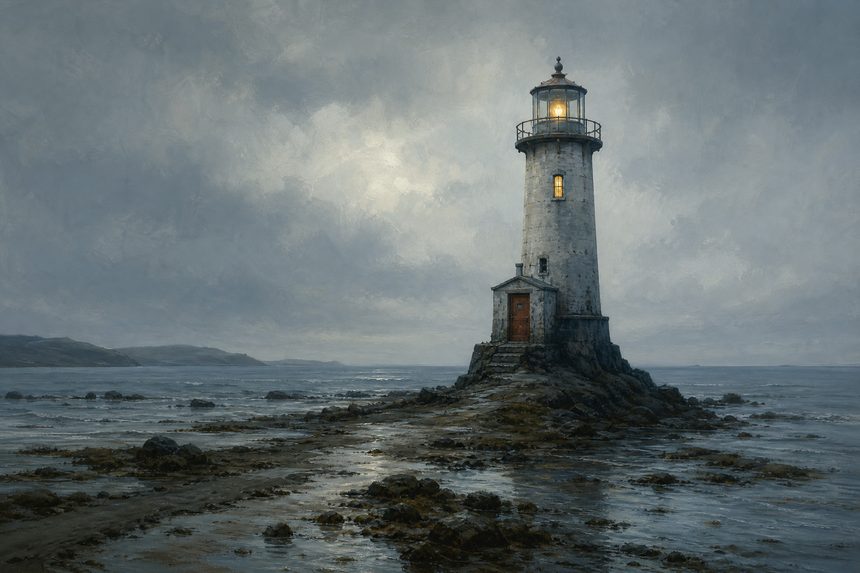
The game gives you a lamp and a set of shutters, and the lamp is always lit. That is the whole of it. You cannot extinguish the light, you cannot move it, and you cannot dim it. What you can do is open and close eleven shutters arranged around the lantern room, which determines where the light falls and, in every room of the tower below, what becomes visible.
Nothing else is added across four hours. There is no second mechanic, no upgrade, no inventory and no character who explains anything. The tower has eleven rooms, each of which is a problem about where light needs to be, and the game ends when the last of them is solved.
What makes this remarkable is not the restraint, which is fashionable, but the fact that the restraint holds under pressure. By the sixth room I was certain a new element was about to arrive, because that is what games do at the sixth of eleven anything. It did not arrive. Instead the sixth room asks a harder question about the same shutters, and the seventh asks a harder one still.
The effect of this is that my attention moved inward rather than outward. In a game that introduces a mechanic every hour, competence is a matter of learning the new thing. Here, competence is a matter of understanding the old thing better, and by the ninth room I was thinking about light in a way the first room had not prepared me for at all, using nothing the first room had not given me.
A game with one mechanic can only get harder by making you smarter, which is a rarer thing than a game with eleven mechanics can offer.
Here is the arithmetic that I think explains this game's quality, and it is not a compliment to its authors so much as an observation about scale.
Eleven rooms is a small enough quantity that two people can revise each of them dozens of times. Every corner of this game has been visited by its makers more often than most rooms in a large game are visited by anyone. That is why nothing in it is approximate: there was time to notice, and time to fix, and no other room competing for that time.
A forty-hour game cannot be revised in this way at any budget, because the number of rooms multiplied by the number of passes exceeds what any schedule permits. The choice, at that scale, is between breadth and finish, and breadth almost always wins because breadth is what a store page can display.
| Property | This game | What a long game trades away |
|---|---|---|
| Rooms | Eleven | Hundreds, each visited less |
| Revision passes | Many per room | Few, concentrated on early hours |
| Mechanics | One, deepened | Several, each shallower |
| Difficulty source | Player understanding | New systems introduced |
I want to describe one room, because it is the moment this game earned the space it is getting here.
The seventh room has no puzzle in it. You arrive, the light falls where you left it, and there is nothing to solve. What there is instead is a window on the seaward side and a view of the water that the game has not shown you before, and the only thing to do is close the shutter that is illuminating the room so that you can see out of it.
That is the entire content of the seventh room: the realisation that the light you have spent three hours placing correctly is also the thing preventing you from seeing anything beyond the tower. It costs the developers nothing. It works because the six rooms before it trained me to treat light as the solution, and it is the only moment in the game where light is the problem.
Two things. The first is that the eleventh room is a summary rather than a conclusion: it asks for everything the previous ten asked for, in sequence, and it is the only part of the game that felt like an exercise. A shorter final room, or none at all, would have ended this better.
The second is that the game does not record where you have been. There is no map, no note of which rooms are solved, and on my second playthrough I spent twenty minutes reconstructing a state I had reached in five the first time. This is not atmosphere, it is an omission, and it is the one place where the small scale reads as a missing feature rather than a decision.
| Element | Assessment |
|---|---|
| Rooms one to ten | Precisely built; nothing approximate |
| Room eleven | A summary; the weakest part |
| Progress tracking | Absent, to the game's cost |
| Second playthrough | Rewarding once the state is rebuilt |
Four hours in which nothing is unfinished, which is a description that applies to almost nothing else I played this year. The absent progress tracking is a genuine irritation and the final room is a misjudgement; neither displaces the seventh room, which I have thought about every week since.